


Guided tour: Eva Máñez: The Wall of Spain

  • art
  • guided tour
  • Mmmhhh tu sembles intéressé par "guided tour". Clique sur les mots clefs qui te plaisent... et hop ne rate plus rien les concernant. A toi de jouer !

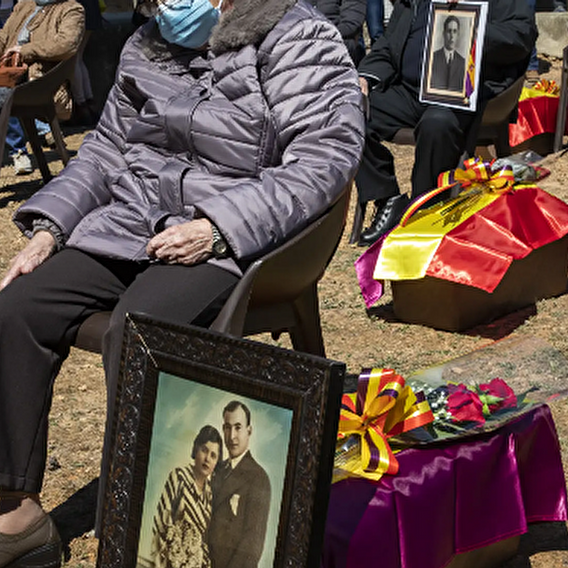
Fifty years after Francisco Franco's death, the many wounds inherited from forty years of dictatorship remain open in Spain. Since his victory in the Civil War in 1939, Franco wielded executive, legislative, and judicial power without any political or democratic control over state institutions. It is estimated that between 1936 and 1945, approximately 150,000 people were executed by the Franco regime, many of whom still lie in mass graves. Photographer Eva Máñez takes us to three key locations to understand this conflict: the mass graves of the so-called "Spain's Execution Wall" in Paterna, the stories of the "vanquished" in the now-touristy region of La Safor, and the dictator's current tomb in Mingorrubio. A photographic and testimonial "post-memorial" journey into the consequences of fascism and 20th-century totalitarianism.

More than 2,238 people were shot against a wall next to the Paterna cemetery (Valencia) during the four-decade reign of terror that Francisco Franco established in Spain. Their bodies were then buried in more than 60 mass graves. The Civil War had ended, but until 1956, the regime continued to execute thousands of people in reprisals. Memory is more tenacious and powerful than forgetting, and after more than eighty years, the victims of Francoism are resurfacing. By opening the graves, archaeologists are uncovering the time that the weight of the earth had stopped: they are documenting the traces of the crime, tracing the positions the skeletons formed, and collecting their fragments to reconstruct the stony tissue of the bodies. In this way, they are restoring their names, their faces, their lives after death. This is why they have come here: the women who keep the flame of their memory alive. They are their descendants, the inheritors of the trauma of their forced absence. They have come to denounce the crime and, if possible, to put an end to the impunity of the perpetrators.

Alongside photos of Paterna, the epicenter of the struggle for remembrance, we will find images of the tomb of dictator Francisco Franco and accounts of Francoist repression in the La Safor region. A journey into the consequences of fascism and 20th-century totalitarianism.

In 2016, photojournalist Eva Máñez began documenting the exhumations of mass graves in the Paterna cemetery and published her work in major media outlets. Throughout this process, she met dozens of courageous women who shared with her a wealth of stories about pain and searching. In 2021, Máñez decided to collect their voices—those of grandmothers, widows, daughters, sisters, and granddaughters: the chronicles of those who have never lost their memories. This exhibition is the result of that journey through space and time.


Centre Culture de Rencontre Abbaye de Neumünster

Where does it take place?

2160 Luxembourg 28 Rue Münster, Grund Luxembourg

Centre Culture de Rencontre Abbaye de Neumünster
28 Rue Münster
Grund Luxembourg



SEE MAP

by enovos logo

Weather forecast (Luxembourg)

sun. 1
/ 4°

REF.#624760 - A MISTAKE? LET US KNOW


Otherwise… check out the agenda

THE AGENDA

see all the things
to do around you

Take Supermiro
everywhere with you.

ios android

Hey, don’t go away...
Get the best
outings around you

All the best deals
events
spots

  • Favorites
  • 2026-02-01 15:00:00 2026-02-01 16:00:00 Europe/Paris Guided tour: Eva Máñez: The Wall of Spain Fifty years after Francisco Franco's death, the many wounds inherited from forty years of dictatorship remain open in Spain. Since his victory in the Civil War in 1939, Franco wielded executive, legislative, and judicial power without any political or democratic control over state institutions. It is estimated that between 1936 and 1945, approximately 150,000 people were executed by the Franco regime, many of whom still lie in mass graves. Photographer Eva Máñez takes us to three key locations to understand this conflict: the mass graves of the so-called "Spain's Execution Wall" in Paterna, the stories of the "vanquished" in the now-touristy region of La Safor, and the dictator's current tomb in Mingorrubio. A photographic and testimonial "post-memorial" journey into the consequences of fascism and 20th-century totalitarianism. More than 2,238 people were shot against a wall next to the Paterna cemetery (Valencia) during the four-decade reign of terror that Francisco Franco established in Spain. Their bodies were then buried in more than 60 mass graves. The Civil War had ended, but until 1956, the regime continued to execute thousands of people in reprisals. Memory is more tenacious and powerful than forgetting, and after more than eighty years, the victims of Francoism are resurfacing. By opening the graves, archaeologists are uncovering the time that the weight of the earth had stopped: they are documenting the traces of the crime, tracing the positions the skeletons formed, and collecting their fragments to reconstruct the stony tissue of the bodies. In this way, they are restoring their names, their faces, their lives after death. This is why they have come here: the women who keep the flame of their memory alive. They are their descendants, the inheritors of the trauma of their forced absence. They have come to denounce the crime and, if possible, to put an end to the impunity of the perpetrators. Alongside photos of Paterna, the epicenter of the struggle for remembrance, we will find images of the tomb of dictator Francisco Franco and accounts of Francoist repression in the La Safor region. A journey into the consequences of fascism and 20th-century totalitarianism. In 2016, photojournalist Eva Máñez began documenting the exhumations of mass graves in the Paterna cemetery and published her work in major media outlets. Throughout this process, she met dozens of courageous women who shared with her a wealth of stories about pain and searching. In 2021, Máñez decided to collect their voices—those of grandmothers, widows, daughters, sisters, and granddaughters: the chronicles of those who have never lost their memories. This exhibition is the result of that journey through space and time. 28 Rue Münster, Grund Luxembourg Centre Culture de Rencontre Abbaye de Neumünster
CLOSE

Favorites

To check your Favorites, connect to your account!

CLOSE

Favorites

To check your Favorites, connect to your account!

CLOSE
CLOSE

Customize your results

To get to your Preferences, connect to your account!

CLOSE

Follow a theme

To follow this Theme, connect to your account!

CLOSE

Follow a theme

To follow this Theme, connect to your account!

CLOSE

Follow some Good Spots

To follow this Good Spot, connect to your account!

CLOSE

Follow a Business

To follow this Business, connect to your account!

CLOSE

Drop your Event

To drop an event, connect to your account!

CLOSE

Yes I want to delete it

Yes No
CLOSE

Well done! Your settings have been applied to the other Supernotifs edition

CLOSE

Drop your Event

To drop an event, connect to your account!

tu n'as pas autorisé la localisation ?

CLOSE
CLOSE
CLOSE

Supermiro is getting a makeover for Brussels and Geneva.
The service will not be available for the next few months in these two areas.
But remains AVAILABLE for Luxembourg and the Greater Region.